Showing posts with label Old Testament. Show all posts

Tuesday, February 11, 2020

For Everything There is a Season


Posted by Clark Bates
January 18, 2020


I was asked last year how I got involved in apologetics, and to be honest, I hadn’t reflected on that for quite some time. In one form or another, I have been engaged in apologetic ministry for roughly a decade, and in all that time of reading, studying, speaking and writing, it becomes easy to lose sight of how everything began. One day you’re just an apologist. You don’t know when you went from studying to be an apologist to being one, but at some point, everything shifted.


As I reflect on it now, I have to say that I entered the world of apologetics a few years after coming to Christ. You see, prior to my being a follower of the Lord I was not a good man. My sins were many and some were illegal. While I had been justified a few years prior, the crimes I committed caught up with me and I had to face justice for them. While I was in prison, I was given a pair of headphones that were useful for two things: listening to AM/FM radio and the television in the common area. I wasn’t much for television, so I used them for radio. The only problem was that the prison house was cinderblock, as was my cell, which creates an excellent barrier to prevent radio signals from getting in. This meant that it was very difficult to find a radio station that I could receive in my cell, let alone a Christian one.

I was able to dial in one Christian radio station, but it only came in if I laid on my bed in my cell, pushed right next to the window. On Sunday afternoons, there was a program that broadcasted in San Diego right around lunch, for 1 hour. That radio program was called Stand to Reason. Yes, this is the same Stand to Reason operated by Greg Koukl, Amy Hall, and Alan Shlemon. For one hour, every Sunday Greg answered calls and dealt with the evidence for the Christian faith. In the darkest corner of my world, his voice was a beacon of light, reminding me that my faith was not vain. It strengthened me in ways that I can never express or repay.

After my release, I returned to my life, began working, and returned to serving my local church as I was able. I bought Josh McDowell’s book, Evidence that Demands a Verdict, and read it cover to cover. Before long, I was sharing in the adult Sunday Schools what I was learning. I read vociferously, digesting all four volumes of Norm Geisler’s Systematic Theology, Frank Turek’s I Don’t Have Enough Faith to Be an Atheist, and everything from Ravi Zacharias. It wasn’t long before I was teaching regularly in the church and fighting a pull on my heart to serve the Lord in some form of teaching ministry. The effectual calling upon me was confirmed by the elders of my church and I approached the pastor to share what was on my heart. To be honest, I thought I was crazy, because there was no way a felon could serve the church (at least that’s what I thought). But my pastor encouraged me to pursue the calling and begin the degree process to receive an MDiv. Not having had any education prior, this meant 7 years of schooling, but I signed up and my journey began.

As the years, and my training progressed I grew in wisdom and stature (metaphorically) with the Lord and others. I began to preach and teach in my church and others. I visited gatherings that were
interested in answering objections to the faith and helped strengthen the Body as I was able. Several years in, I was gifted with a scholarship to attend Frank Turek’s Cross Examined Instructor’s Academy, and I can honestly say that it changed my life. I learned how to focus my time and work in apologetics and to become a master of just one topic, rather than mildly familiar with many. I was fortunate to attend two Academies at different years and build a strong working relationship with many fellow apologists. From then to now, I have operated this website, completed my Master’s degree and continued to speak at various events in the areas I’ve lived. I’ve seen apologetics ministry go from being something almost unheard of to existing in every corner of the internet. For good or bad, apologetics and apologists are everywhere, and the Christian faith, to one degree or another, is being defended. For that I thank God.

But now we come to where I am at today. As I sit at my keyboard, I am in the final stages of a Master’s Thesis for my second Master’s degree. I took on this second degree as I felt the call of God on my heart with more clarity and a call to academic study. To attain a PhD, I must have a Master’s of Theology, so here I am, at the end of that road. To reach this destination I was given the inexpressible gift of a Fellowship at Phoenix Seminary to work under the intellectual giants, Dr. Peter Gurry and Dr. John Meade. I have been blessed beyond measure to travel to Oxford, England and learn paleography; to work with the Museum of the Bible and the University of Birmingham as a transcriber of Greek manuscripts; I have held the oldest fragment of the Gospel of Matthew in my hands, and I have humbly sat under the teaching of great and godly men and women. The baby Christian in that San Diego prison cell could never have fathomed where his life was headed.


All of that to say this, Lord willing, I will be working toward a PhD next year, and it will demand all of my focus and time for several years. Assuming anyone regularly reads this blog, it has probably been noticeable that I have posted less and less in the last year. This is because the sheer demand on my time is already very heavy and as much as I love apologetics, I simply cannot keep up. I have taken a great deal of time delaying this decision. I have prayed about it. I have sought counsel about it. And I believe that it is the right thing to do. At the end of this month, I will shut down this website and close the social media platforms for ExeJesus ministries. If asked, I will gladly speak at any gathering that would have me, but my time as an apologist has come to an end. I will always be thankful for everyone who encouraged me, supported me, and challenged me along this journey. And I will always defend the faith with love and compassion whenever I am asked about the hope that rests within me.


If I may pass on some parting words from ten years of observation, it is this: the best apologetic is the one that listens to the other person before speaking. It is the one that cares about the skeptic in the same way that it cares about the Christian. Apologetics is a part of evangelism, but it is not evangelism. Evangelism shares the beauty of the Gospel of Jesus Christ with a lost and dying world. You can be an excellent apologist and have answers for every question, but never share the Gospel. My parting plea to the numerous young apologists out there is simply this: love your enemy, because they will know we are Christians by our love. There is no other way.


May the Lord Bless You

May He Keep You

       May He Make His Face to Shine Upon You

  And be Gracious to You

         May the Lord lift up His Countenance Upon You

And Give You Peace.


Let's Talk About Preservation


Posted by Clark Bates
November 1, 2019


Let’s talk about preservation.  Preservation is one of those Christian doctrines that is largely presumed in a discussion rather than explained or thought through.  Essentially, the doctrine of preservation is the belief that since God has promised that His word will never pass away, the word of God found in the books of the Bible must be preserved for all time.  The reason this doctrine isn’t often addressed on its own, is because it usually gets enveloped into an argument for the reliability of the text.  Discussions focus on manuscripts, variants, text categories and the like.

For critics like Dr. Bart Ehrman, the existence of variants in the earliest manuscripts of the New Testament patently demonstrate that there has been no preservation of God’s Word. For others, the need to maintain the doctrine of preservation leads to adopting a particular translation of the Bible as the “only inspired and inerrant word of God” or to prefer the text that is found in the majority of manuscripts. And others choose to adopt a particular form of the text adopted by the Reformed creeds. In general, these slightly extreme approaches are bound up in a generally honorable desire, to defend the doctrine of preservation.

The doctrine of preservation is entirely biblical (Ps. 12:6-7; Is. 40:8; Lk. 21:33) and if one believes that God must work miraculously through time to preserve every single word, the desire to adopt a specific form of the text makes perfect sense.  I believe in the doctrine of preservation even though I do not hold to any of the positions above, but this post isn’t about breaking down the details of the doctrine, it’s about sharing what I believe to be an excellent example of God’s actions in history, through completely natural processes, to preserve his word for the next generations.

It's all Greek


The direction of my academic work rarely intersects with content that I would consider applicable to
this site, but this week I believe it does. My present studies involve the transition in Greek manuscripts from the handwriting commonly called Majuscule or Uncial to what is called minuscule.  In the earliest New Testament manuscripts, the Greek writing was entirely capital letters, with no spacing; this is what we call “majuscule” Greek.  Over several centuries the Greek majuscule was refined into various styles seen fit for writing books, referred to generically as a “book-hand”.  One of the most used styles by the 4th century onward is now called the “biblical majuscule” and is best evidenced in Codex Sinaiticus and Vaticanus.

The majuscule Greek dominated all literary works for hundreds of years, until the 9th century when a new book-hand abruptly appears on the scene. Nothing like the refined beauty of the all-capital majuscule style, this form of writing was lowercase.  Not only this, but it was written in a cursive style of interconnected letters in random places and marked with several combination forms of letters, called ligatures. This new hand would later be called “minuscule” for its lowercase approach to the text and becomes the predominate style of writing until the time of the printing press in the 16th century. So influential was the minuscule that the earliest Greek typefaces used in printing were designed after the minuscule writing style, so much so that ligatures are even found in the earliest printed Greek New Testaments.

The question that puzzles many (okay not many, but a select few that have nothing better to do) is why did the style of writing change as it did, and when did this actually begin? It’s impossible to believe that our oldest example of the Greek minuscule book-hand is the first time it appeared.  Many of these studies are very technical, but most paleographers are in agreement on two features:
  1. The minuscule book-hand must go back to at least the 8th century
  2. All evidence suggests that this book-hand originated in the Stoudium monastery in Constantinople
It’s these two details that I want to expand on, briefly.

A Brief Byzantine History


In the 4th century a Roman diplomat of high social status named Flavius Stoudios founded a monastery in Constantinople. Very little is known of the monastery in the following centuries, but the surrounding Empire experienced immense difficulty.  As various Emperors rose and fell, the wealth of the empire grew, but suffered under excessive expansion of territories. The plague decimated people and grain storages and people-groups living on the outskirts of the Empire began to revolt. Persia began to encroach into the northern boundary, Avars invaded in the West. By the 7th century, the Byzantine Empire was a shadow of its once great glory. At this same time, a new religion was rising in the East led by a man named Muhammed Ibn Abdullah: Islam.  The Islamic faith spread rapidly in the 7th century, conquering Egypt and the Persian Empire, threatening the existence of the
Byzantine Empire and Constantinople.

The Islamic invasion was suppressed for a time, but their conquering of Egypt cut off the supply of papyrus to the Empire resulting in a shortage of writing materials. The alternative material, vellum, made from animal skins was costly and not producible in mass quantities in a financially diminished Byzantium.  Within Christianity, this was the era of the Chalcedonian Council and the Christological battles against Nestorianism and the nature(s) of Christ. By the 7th century, a new conflict had arisen called the Iconoclasm. This dispute in the church revolved around the use of icons (images of Christ and Mary) in worship or in churches. The iconoclasts argued that they should be destroyed, while the iconodules argued for their necessity.  It is here that the monks of the Stoudite monastery reappear in history.

The Stoudite monks opposed the iconoclastic emperors and churchmen, arguing fervently and writing
excessively in favor of the use of icons in the church. So adamant and vocal were they, that many were persecuted, defrocked and exiled.  Among them was the abbot of the monastery, Theodore the Studite.  Theodore didn’t begin his life as a monk, but was trained to be a bureaucrat, loving the sciences, reading and writing.  He was convinced of the monastic lifestyle by his uncle Plato, also an abbot, and also trained in reading writing and the sciences.  Under Theodore’s leadership the Stoudite monastery became a center of literature. The monks were diligent in labor and encouraged to read and copy books regularly.  How would this be possible in a time of material shortage like I mentioned above?  The monks raised sheep, both for food and for their skins to use as material.  They became a self-sufficient center of learning.

In the obituaries written of Theodore and Plato, it is said that they possessed a style of writing that is difficult to translate into English.  The use od the Greek word is strange, but when combined with its context, the suggestion is that they wrote with a sweeping motion and with great speed. It is presumed that Plato taught this style to Theodore, who, in turn, taught it to his monks.  This is believed by some to be the beginning of the minuscule Greek hand. Why? Because the earliest dated example of this book-hand is a Gospel text referred to as the Uspenski Gospels and it is signed by a monk.  Nicholas the Stoudite, servant of Theodore.

Over time, the church returned to the use of icons and the monks were allowed to return, yet their monastery had become so influential in its operations that the Empress Irene asked that they send monks to other monasteries and train them. In effect, these monks took the minuscule book-hand they had learned from Theodore and spread it to the rest of the Christian world, where it was then recopied, taking on regional features of its own, and eclipsing the previously used majuscule hand. Within a few centuries, the demand for book making increased to such a level that it rocked even the archaeological evidence left behind.  In the 8th century a scant 58 New Testament papyri remain, many of which are fragmentary.  By the 9th century, and the beginning of the minuscule book-hand, there are 208, by the 11th century there are 836 and it grows astronomically from there.

Allow me to take this one step further by going one step backward. If you examine the non-literary papyri of the 5th – 7th centuries, it is possible to trace the expansion of a sloppy minuscule writing style, very useful for writing deeds, receipts, and the like.  These all come from Egypt of course, and are nowhere near the Stoudite monastery in Turkey.  However, the monastery was founded by a Roman diplomat, who would have been familiar with these non-literary styles of texts and was likely exposed to this very early form of the minuscule Greek. To populate the monastery, monks were brought in from the Ivory Coast of Africa on a trade route that would have taken them through Egypt, exactly where we find these papyri, exposing the monks to this style as well. What this may suggest is that the Greek minuscule writing style can be pushed back farther than originally thought, possibly back to at least the 6th century.

Conclusion


So, what does all this mean for preservation?  Let me show you what I see, from 10,000 feet. An educated Roman consul creates a monastery a century after the reign of Constantine from which a monk trained in the love of literature would eventually lead. It is populated by monks exposed to a very new and foreign way of writing Greek that also happens to resemble a Latin style of writing, once refined. This monastery becomes an outpost of book care and production, even establishing its own provisions for material in a time when the outside world is being ravaged. They are led by scholars, to become scholars, and influence other monasteries with them. They perfect a writing style that is faster than the one prior to it and aesthetically resembles the Latin, making it approachable in all regions of the Empire. These monks take this style of writing into the rest of the Empire right at a time when economic upturns promote a love and demand for literature. A demand for books that can be written quickly and stylishly. A demand that the earlier majuscule style would not have been able to meet. Without the minuscule hand, the coming Byzantine Renaissance would have died before it began, but because a thousand small changes took place centuries prior, exactly the right people, were in exactly the right places, at exactly the right time, to enable the largest period of book production ever seen prior to the printing press.

I call that divine preservation. I call that providence. In all times, for all people, God has provided His word and He has ensured that it will last even through the most unlikely of times.


What's a Christian to do With Leviticus?


Posted by Clark Bates
September 5, 2019


The book of Leviticus.  The mere mention of it brings images of a barren desert to the mind of most Christians.  It is the book that shall not be named.  It is the place “read my Bible in a year” plans go to die.  Fewer books cause the amount of struggle than the book of Leviticus.  Not because it’s convicting to the reader, or because its deep theology requires contemplation (although both could be true in some cases).  No, it causes struggle because it’s…. just….so…. boring.

What is a sheaf offering anyway?  Or a wave offering?  Why do they have to kill so many animals?
  What does any of this have to do with Christians today?  Why can’t I stop picturing Monty Python and the Holy Grail every time I read it?  Ultimately, the book of Leviticus is lost on many Christians.  Its purpose is unclear, it’s bloody sacrifices turn the stomach and the list of punishments seems excessive to our sensibilities.  What’s more, the content of Leviticus has become a playground for skeptics and unbelievers to use as ammunition against the Christian faith.  So, what do we do with this book?

Some Basics


The book of Leviticus is named from the Latin Vulgate meaning “pertaining to the Levites”.  In Hebrew it’s called וַיִּקְרָא (vō·kä·rä, “and he called”) based on the first word in the Hebrew text.  Various Rabbinic traditions also referred to it as the “law of the priests” or the “law-book of sacrificial offerings”.  It is counted as one of the five books of Moses, also known as the Torah or the Pentateuch, and is among the most valuable and oldest books of the Jewish tradition.

Leviticus is essentially a rule book for the Levitical priesthood, but ore than that it is the guidebook for the relationship between the nation of Israel and God.  It can be summed up with the repeated phrase, “Be holy, because I (God) am holy”.  It’s filled with very specific instructions regarding sacrifices and offerings, lists of unacceptable sins and the punishments that attach to them.

Leviticus is blunt and bloody, and it flies in the face of most modern, Western sensibilities.  But, it is the source for the character of the nation that was chosen by God and the manner in which they were to carry themselves as a nation set apart from those around them.  As Christians, it is difficult to determine where we stand in relation to this book.  One option has been to simply assert that it doesn’t apply to us.  That was for them, then and the New Testament is for us, now.  Another approach has been to assert that it’s all applicable and its guidelines are for Christians as well.  However, even those who affirm this, don’t actually burn witches or sacrifice goats.

The Message of Leviticus


Firstly, Leviticus communicates that God is Holy (20.3;22.32).  Because of this holiness mankind cannot enter into His presence.  The manner in which the Israelites set up their camp reveals this separation:


Space                                      Person
The Sanctuary                         Priests only

The Camp                               The Israelite People

Outside the Camp                  The Temporarily Unclean

The Wilderness                      Unclean Spirits


This establishment demonstrates how a persons spiritual position relates to their proximity to the Lord.  What’s more, the closer a person or thing gets to God, the holier it becomes:


Space                               Person
The Inner Court               Levites

The Holy Place                Priests

The Holy of Holies          The High Priest


Understanding this relationship between the people and God is foundational to understanding the rest of the text.  The ritual purity laws and cleansing rituals, kept the people aware of their need for holiness.  On those days when an Israelite was to enter into the sanctuary, they would need to be even more aware, given the closer proximity to the Lord and the need for ritual holiness.

Also, death is clearly combined with being unclean.  Death defiles the man.  Even touching a carcass renders the person unclean (11.24-5; 39-40).  Contact with a human corpse was worst of all, to the extent that a priest couldn’t contact a corpse unless it was his wife (21.1-4; 10-12).

Holiness coincides with justice.  Because God is holy and He demands the people to be holy, then they must require justice (24.20).  Retribution must fit the crime, and crimes must be punished.  Additionally, God’s holiness is revealed in Leviticus through His love.  The one’s who love God are told to “love [their] companion who is like [them]” (19.18).  Because of this love, the Israelites are to treat others justly and lovingly (19.15-18).

Because God is holy and the average person is not, a means to be made pure was necessary.  Enter the sacrificial system.  Sin results in consequences, and nothing made this more evident than the sacrifice.  So prevalent was the need for sacrifice that unintentional sins required the life of an animal (4-5).    Logically, this resulted with the realization that sin brings death and the only way to forgive this sin was for something else to take the sinner’s place.  This is most clearly stated in 17.11,


“For the life of the animal resides in the blood: I have assigned it to you to make expiation on the altar, for your lives, because it is the blood that makes expiation by the life.”


It was not enough to merely follow the ritual, however, as the nation would later be judged for empty ritual practice.  It was understood that God searched the heart of the individual and that brought the forgiveness.

So, what do Christians do with this book?

Leviticus and the New Testament


The Levitical system of sacrifices reveals the need for the sacrifice of Christ.  We read that the pattern of things in the Torah was a shadow of what was to come (Heb. 10.1).  The sacrifices of bulls and goats, even flour and birds, were not able, in and of themselves to cleanse a person from sins (10.4).  They were effective because of their value in the once-for-all sacrifice of Christ (Heb. 9.12-14).

Beyond this, there are the more difficult aspects of this book, most notably the requirement of a sin offering for a woman who has had a child or menstruated, a leper, and even a bodily discharge.  Why in the world are natural bodily functions and diseases considered a sin?!  We might be tempted to point out that the people of this book were clearly savages or simply ignorant of the way the body worked and this is the result of these requirements.  We might simply want to reject the book as a whole, because of this.  I would suggest that neither would be correct.


Consider that the sin sacrifice not only applies to everyday bodily functions, but even to UNINTENTIONAL sins!  Sacrifice is expected for sins you didn’t even consciously commit!!  How is this fair?  How I this just?  You might even respond that it’s impossible to remain clean and holy under such conditions!!!

And you’d be right.  Because that’s the point.

The sacrifice is required because God is holy.  It applies to every part of daily life because every part of our humanity is unholy.  This is the message of Paul (Rom. 5.12-21; 8.5) and John (1 Jn. 2.2; 3.5).  It is why Jesus came to be sin on our behalf (2 Co. 5.21), the just for the unjust (1 Pet. 3.18).  He did this, because it is impossible for any human being to keep himself holy or be able to approach God through his or her own efforts.  The message of Leviticus is the message of the cross.

Conclusion


Does the book apply to Christians today?  Yes, and no.  Without Leviticus the resurrection becomes meaningless.  Without all that had been foreshadowed in the Old Testament, the action of Christ in the New becomes nothing more than an interesting historical event.  To abandon Leviticus is to strip the cross of its power, so in all these ways Leviticus most definitely applies to Christians today.
But it doesn’t, in so far as the rituals are concerned.  Why?  Because Jesus was the last sacrifice required, and he stands in the presence of the Father on our behalf eternally (Heb.5.1-10; 8.1-6; 10.19-23).  The need for Christians to remain separate from the world as exemplified in the separation of cloths and kinds of cattle (Lev. 19.19) or the need to remain morally pure as seen in sundry passages (19.20-22; 18.6-10) is still true (1 Jn. 2).  The punishment for these crimes, particularly those deserving death still stand, but it is no the Christian who is to impose them, but God alone (Rom. 12.19; 13.4).  Likewise, death will come to those who continue in sin without taking advantage of the means by which God has provided for forgiveness (Jn. 3.16-20).


Dear Christian, if the book of Leviticus has been a cross you felt you had to bear up to now, I pray that you will leave here seeing it as the cross Christ bore on your behalf.


Where do You Want to Die? A Plea for Caution


Posted by Clark Bates
March 22, 2019


Everyone has one.  That mountain they're ready to die on.  There’s always at least one thing that you will not abandon, no matter how hard you’re pushed.  I’m willing to bet that, even if they’ve never thought of one, every person on the planet has a such a position.  This is a good thing.  I believe firmly that everyone should have convictions and that these convictions should be something that they will fight for.  You might say that’s a mountain I would die on.

That’s not to say that we all shouldn’t be willing to be reflective and analyze our convictions over the years, to be certain that we aren’t holding to something that may not be true.  After all, circumstances change, new evidence can be revealed, and as Socrates famously said, “The unexamined life is not worth living.”

The question everyone should ask themselves routinely regarding their particular “mountain(s)” is, “Do I need to die here?”  Basically, reflect on the issue at hand and determine if it really is absolutely necessary to your worldview that it be true, or that your position never change.  I bring this up because the tendency among Christians, and probably everyone else as well, is to make minor details of Christian belief the most important.  Having grown up in an IFB (Independent Fundamentalist Baptist) community, I was well-versed in the hundreds of minor details that were “essential” for someone to believe if they were a “real” Christian.

Examples?  This may be where I lose readers but there are many.  Does it matter which translation of the Bible you use?  What about wearing a hat in church?  Can a Christian smoke? Drink? Dance?  In the world of apologetics, we have many as well.  Does it matter how old the universe is?  Can you be a Christian and believe in evolution?  What if the Gospels were written later than 70 AD?  Does it matter if the meaning of a beloved Bible verse happens to be different than you’ve always thought?  What if the Canon of the Bible wasn’t ever actually decided formally?

Ask yourself, are these non-negotiables for you, or is there room for differences of opinion?  For many years, several of these positions were non-negotiables for me.  I would never have agreed that you could believe in an old earth, let alone evolution, and be a Christian.  I always believed that the New Testament existed as the 27 books we use today and that there was never any dispute in the matter.  And don’t even get me started on dancing (blame the IFB, but hey I was a kid, I didn’t know any better).  These days, whether by wisdom or folly, I don’t consider any of the items listed as non-negotiables of my faith.  Why?  Because Scripture does not affirm them to be, and my knowledge of both the positions themselves and those who hold to them has broadened.  Mind you, I do still have mountains I will die on, but these are not among them.

Mosaic Authorship = Biblical Inspiration?


I'm writing this for two reasons, the most important of which is that if you make everything a non-negotiable you will never have a clear grasp of the Gospel of Jesus Christ, because everything will get subsumed into the gospel.  If the gospel is everything it may as well be nothing.  The second reason is that if you or your children are led to believe that certain things are “mountains to die on” in Christianity, where the Bible itself does not, you are building a house of cards with your faith and it will come crashing down.

I was reminded of the importance of this, earlier in the week when I saw an ad on social media for an upcoming movie seeking to prove that Moses was the author of the Torah (the first five books of the Bible).  The tag line for the ad was, “Is the Bible the inspired Word of God? Or is it a book of fables and myths?”  Now, if you can’t spot the issue here, what this seems to suggest is that either Moses authored the Torah or the Bible is not inspired and must be reduced to fable and myth.  Do you see how tenuous a claim that is?  I even asked the question of the company posting the ad, how one would have anything to do with the other.  I did receive a reply from another Christian seeking to defend the statement, and he clearly felt it was necessary to believe that Moses wrote the Torah.  In our brief discussion, I never stated whether I believed in Mosaic authorship or not, only pointed out that the Bible could be the inspired Word of God even if someone else compiled the stories of Moses and wrote them down.  This didn’t go over well, but the conversation remained gracious and for that I’m thankful.

So, allow me to make my point a little more clearly here by using two examples: Mosaic authorship and the authority of the New Testament.  I’ll begin by stating that I actually do believe that Moses is the most likely candidate for the author of the Torah, and has traditionally been the author for thousands of years.  I also defend both the more conservative dating of the New Testament and the traditional authorship of the Gospels and Epistles.  That being said, these are not mountains to die on, and I don’t believe they should be for you either, though I can’t make that decision for you.  I only hope you will be willing to hear what I am about to say and take the time to reflect on the matter more.

Mosaic Authorship


What if Genesis – Deuteronomy were written by someone other than Moses?  Would that mean the Bible is not inspired?  The argument in the positive rightly points to the many places in the New Testament wherein the “law” is said to have been written by Moses.[1]  Therefore, the argument goes, if Moses didn’t write the Torah then Jesus is lying when he credits it to Moses and that makes the New Testament false, i.e. uninspired and not the Word of God.  Admittedly, there is logic to this argument in so far as it goes, and it is certainly true that Jews have always held, at least until modern times, that Moses was the author of the Torah, and Jesus does seem to suggest that Moses wrote the law.

Now, allow me to play devil’s advocate for a moment.  Modern scholarly consensus is that Moses did NOT write the first five books of the Bible.  The most common theory involves several variations on what is known as the Documentary Hypothesis or JEDP.[2] This theory maintains that the Torah was written long after the time of Moses, likely in the 5th or 6th century BC after the exile.  What’s more, there is little-to-no Mosaic influence at all, but rather various scribes can be detected within the texts based on their use of the divine names “Jehovah” (YHWH) and “Elohim”, or the focus on priestly functions or revisions of the law.  These various scribal works, it is claimed, were then compiled by later editors to create what is now the first five books of the Bible.  This theory is clearly, and understandably, offensive to most believers because it flies right in the face of what they’ve always believed, and stands directly opposed to what the first five books of the Bible seem to say.  It’s also not unrelated that many who hold to the documentary hypothesis deny most, if not all, the historicity or value of the entire Old Testament corpus.

But here’s the rub, what if they’re right?  What if I modified this position just a little bit and pointed out that while Moses is the main character in at least four of the five books of the Law, none of the books are themselves plainly authored?  If you look at them again, you might notice that all of them are formally anonymous.  Granted, 3 of them begin with the phrase, “then the Lord spoke to Moses…”, but this is the recording of a narrator.  The texts are entirely in the third person with the exception of direct discourse.  You might say, and some have, that the Torah is formally anonymous in the same way that the Gospels are.  In fact, and this is just something extra to chew on, the narrative of the Gospels in relation to Jesus are strikingly similar in form to the narration of Moses in the Torah.  No one claims that Jesus wrote the Gospels.  Therefore, it is entirely possible that, while the narrations of the Torah contain accurate historical accounts of the manner in which Moses came to be the leader of Israel and the manner in which the nation was given the Law through him, the actual compilation of the books and the narrative that links the stories together was created by another individual(s).

I will pause here to remind you that I subscribe to Mosaic authorship, so the pitchforks and torches can hopefully be put away, but even if the reality is something like I’ve described above, what does it change?  In most instances of the NT, Jesus refers to Moses writing something specific contained within the law, which is supported by the account in the OT. Therefore, there is no contradiction in saying that Moses wrote x or even that Moses gave Israel the law, AND there being a third person compiler of these accounts.  Does it change the value, quality or inspiration of the Torah or the Bible as a whole, if the author of any of the books is someone other than Moses?  Do we not subscribe to the authority of the rest of the OT even though more than 80% of the books are written by unknown authors?  Do we not submit to the authority of the epistle to the Hebrews in the NT despite having no knowledge of its author?  If you can answer, “nothing changes” then maybe Mosaic authorship isn’t a hill to die on, and it has nothing to do with the inspiration of Scripture.  But this also leads me to the second example.

The Authority of the New Testament


Whenever a defense of the New Testament Canon is provided in an apologetic setting, one of the key points is explaining how the books were selected or identified.  Most, myself included, will point out that the books had to be written by apostles, or have apostolic authority.  Exceptions are usually given for the epistles of James and Jude, as well as the Gospels of Mark and Luke, given that these were not apostles.  Mark’s Gospel is bolstered by the claim of the church Father Papias, writing in the 1st century, that Mark wrote down what Peter told him, thus making Mark’s Gospel really the Gospel of Peter and thus, apostolic.  Therefore, the claim goes, if the book could be traced to an apostle or close relation of an apostle it was considered canonical.

Just like above, I will pre-empt my devil’s advocate stance by saying that I subscribe to traditional authorship.  There is even an entire page of this website devoted to who wrote the New Testament where I lay out the arguments for that authorship.  But here’s the reality, if we set aside our commitments to Christian tradition and what we’ve always been taught, or even what is cleverly argued, there are several books of the NT that are anonymous.  While many have taken pains to deciphering how we can be reasonably be sure that the four Gospels were authored by the very men whom they are named after, they are still formally anonymous.[3] Nowhere in the Gospels themselves do the authors plainly identify themselves.  In a similar fashion, the epistle of James and Jude do not identify which James or which Jude.  Both refer to themselves as “slaves of the Lord (Jesus Christ)” and Jude states that he is the brother of James, but given that both names are counted in the most popular names of the region in the 1st century, any more specificity in identifying them must be based on reasoned conjecture and nothing more.  That’s not to say that the reasoning is unsound, far from it, it just means we need to be willing to see the evidence for what it is.[4]

Now, if my position on the Canon of the New Testament or the Inspiration of Scripture relies on apostolic authorship of the books, being faced with this kind of information could destroy my entire faith in the books as a whole.  It may even damage my belief in the inspiration of Scripture.  However, if I take a step back and really consider the arguments for canonicity, the apostolic qualification for books was NOT about who the author was, but rather if the text carried apostolic authority.  So, the test is not authorship but authority.  This may not seem like a difference, but it is.
Consider the argument often used that Irenaeus argued that the four Gospels were authored by those to whom they are ascribed.  If you look at his actual argument in full, two points emerge:
  1. He’s arguing not for their authorship per se, but that the teaching contained within the Gospels can be traced back to the teaching of the apostles of Jesus and that they did not require “perfect knowledge” to teach, and
  2. He’s making this argument in response to the claims of the Gnostics (specifically the Valentinians), that they are the ones who carry the teaching of the apostles.[5]
So, while this quote can be helpful in demonstrating early support for the authorship of the Gospels, it’s actually not why Irenaeus is writing what he does.

Now consider the difficulty of claiming apostolic authorship for canonicity with a book like Hebrews.  The author is completely unknown!  Sure, you can claim that many “think” that Paul was the author, but there’s nothing in the book that states this, and the language of the letter doesn’t match what we see in the Pauline letters.  Additionally, while I don’t agree, the arguments against several of the canonical Pauline epistles would suggest that many of the books of the NT are not apostolic.  However, when you realize that a book could be written by non-apostles, and several were, without it bothering the church for hundreds of formative years because a book was deemed canonical if it carried the authority of an apostle, all of these arguments against the canon disappear.[6]

Conclusion


I’ve spent quite a bit of time pointing out what I don’t think are mountains to die on, but I would be remiss if I didn’t mention what I DO think is a mountain to die on.  To put it briefly, those doctrines espoused in the Nicene Creed are non-negotiables of the Christian faith.  Prior to the time of the Creed, the Early Church maintained only a few mountains to die on: 

There is but one God and He is the Creator of all things.  
He has one, only-begotten Son, Jesus Christ, by whom alone salvation is possible.  
This man Jesus was truly God and truly man, born of a virgin, died by crucifixion, 
was resurrected on the third day and ascended into Heaven.  
The Holy Spirit of God has been given to His people through which they will receive power to tell others of the salvation made available to the world.  

These are, without a doubt, non-negotiable for the Christian.  All other points are ancillary to these, and while they will each have their own level of importance, there will always be room for discussion over them, and there always should be.

So, there is no misunderstanding me, please know my heart on this issue.  When I give lectures at a church and I bring up matters such as this, I am quick to point out that one day, the people will hear about these issues.  They will either hear it from someone like me or from someone like Bart Ehrman, and I’d much rather they hear it from me.  I want the church to be known for its level-headedness and careful thinking.  I want Christians to take captive naivete surrounding their faith and be prepared for the opposition they will face in the world.  I want them to know the challenges so that their faith takes hold of the fertile soil and digs deep roots, because the birds of the air and the thorns of the deep will come to try to snatch it away and choke the life from them, but a seed sown deep is not easily removed.  I will close with a quote from a friend of mine now at Tyndale House in Cambridge concerning the approach to the Bart Ehrman’s of the world:


“The problem isn't 'Ehrman (full stop)', it's 'Ehrman+antagonistic professor+ministers letting Christians hear about this stuff from Ehrman and antagonistic professors first'. Treating it as if Ehrman is the sole problem is a *really* bad idea because it leads to statements like ‘This is why I am wanting an actual list, to be able to demonstrate how deceptive Ehrman is’ and ignores our own failures to let our church members know what's out there before they hear it from someone who wants to use it in a way that would destroy their faith. 

Yes, Ehrman sensationalizes his point to draw conclusions that should not necessarily be drawn from the data he gives. But Christians do it too in our desire to respond to/disprove him. It's never a good idea to misrepresent the truth. Far better to be honest about what God has given us. To use a phrase that a couple of friends of mine use, there is a ditch on both sides of the road—don't fall into one of them because you're trying to avoid the other one.”


  • Author's note: In no way am I demanding that those who read this article agree with me in my positions, nor by citing other positions (i.e. theistic evolution) am I suggesting that I agree with them.  My only desire is that every believer be willing to reflect on the positions they have historically considered non-negotiable and simply ask themselves why those positions are mountains they choose to die on.


[1] Jn. 1:45; 5:46-7; Lk. 20:28; Mk. 10:5; 12:19, etc.

[2] J – Jehovah; E – Elohist; D – Deuteronomist; P - Priestly

[3] I find the manuscript evidence for consistent titles of the Gospels, early recognition of the church fathers with these titles and the clear means by which the entire church from its inception were able to distinguish between them (after all you had to know which Gospel you wanted copied for your use) to be substantial in supporting the traditional authorship, or at least, the fact that the Gospels have always been transmitted under the same names as we have today.

[4] This is to say nothing of the challenges to various Pauline Epistles that, especially to those untrained in the original languages, can be quite convincing.

[5] Irenaeus, Against Heresies, 3.1.1 – 3.3.1-4.

[6] By “apostolic authority” I mean that a book could be written by someone other than an apostle (i.e. Jude, James, Mark, Luke, Hebrews) yet contain teaching which clearly corresponded to the teaching of the apostles to the church.  If the message of the book met this standard it became canonical.  This also helps understand why books like the Gospel of Thomas, the Gospel of Peter, and others were not accepted, even though they were initially used by the church.

God Demands Human Sacrifice


Posted by Clark Bates
March 16, 2019


In the summer of last year, I was blessed with the opportunity to study at the University of Oxford in the United Kingdom.  The city is truly amazing, with a history so profound that it’s often hard to fathom that you’re actually walking down the same streets as some of the most famous minds of all time.  I stood in the gardens where Lewis Carroll was inspired to write Alice in Wonderland, wept on the spot where Latimer and Ridley were burned alive for the Protestant faith, and even held the oldest piece of the Gospel of Matthew in my hands.  It was truly a profound experience, but one of the more fascinating days for me was a visit to the Pitt Rivers Museum.  This museum houses artifacts from every age of civilization and even many fossils from long before.

In one corner of the immense building is a two-story room lined with the various weaponry throughout history.  In the center are curiosities from all over the world, used by peoples long gone.  Suffice it to say, there are some very dark elements to some of these exhibits, not the least of which is the display of actual human heads shrunk by tribes in the Amazon, as well as the pieces of victims of cannibal tribes recovered many years ago.  Amidst this gruesome display, much is written on the practice of human sacrifices in cultures all around the world, and while this topic is often too disturbing for many to reflect on, it has made me consider an interesting, although morbid, truth: The practice of human sacrifice can be found in all regions of the world.

A Sacrifice I Desire...


The Bible even speaks of human sacrifice, specifically in the form of infant sacrifice.  In the book of 2 Kings we read of King Josiah enacting sweeping changes across the land of Israel:


“He brought all the priests from the cities of Judah and ruined the high places where the priests had offered sacrifices, from Geba to Beer Sheba.  He tore down the high place of the goat idols situated at the entrance of the gate of Joshua, the city official, on the left side of the city gate. . . . The king ruined Topheth in the Valley of Ben Hinnom so that no one could pass his son or his daughter through the fire to Molech.”  (2 Ki. 23:8-10)


The phrase “pass his son or his daughter through the fire to Molech” refers to the Canaanite practice of offering living infant children to the god Molech, by burning them alive on his altar.
Later on, in a prophecy given to Jeremiah, we read that YHWH will judge the nation of Israel for committing this very same practice:


“They set up their disgusting idols in the temple which I have claimed for my own and defiled it. They built places of worship for the god Baal in the valley of Ben Hinnom so that they could sacrifice their sons and daughters to the god Molech.” (Jer. 32:34-35a)


The act of human sacrifice was common in the Ancient Near East as a means of finding favor with the gods.  Archaeology has confirmed this practice not only here, but all over the world:
  • Between 1922 and 1934, archaeologist Sir Leonard Woolley excavated the Royal Cemetery of Ur, wherein several rooms were unearthed containing human remains in what appeared to be a primitive human sacrifice ritual.
  • In Homeric legend, the King Agamemnon sacrifices his daughter, Iphigeneia, to the goddess Artemis, so that the Greeks would be victorious in the Trojan War.
  • Phoenicians and Carthaginians sacrificed infants to the gods. In the child cemetery known to archaeologists as Tophet (literally “roasting place”), spoken of in OT, it is estimated that 20,000 urns containing the remains of infant sacrifices were found.
  • According to Diodorus Siculus' Bibliotheca historica there were ancient Greeks in the 1st century BC that also practiced infant sacrifice. He writes, "There was in their city a bronze image of Cronus extending its hands, palms up and sloping toward the ground, so that each of the children when placed thereon rolled down and fell into a sort of gaping pit filled with fire."[1]
  • Cicero claims that puppets thrown from the Pons Suplicius by the Vestal Virgins in a processional ceremony were substitutes for the past sacrifice of old men.[2]
  • According to Roman sources, CelticDruids engaged extensively in human sacrifice.  According to Julius Caesar, the slaves and dependents of Gauls of rank would be burnt along with the body of their master as part of his funerary rites. He also describes how they built wicker figures that were filled with living humans and then burned.[3]
  • The ancient Chinese are known to have made drowned sacrifices of men and women to the river god, Hebo.[4]
Given the widespread nature of human/infant sacrifice, it would seem that there is something common to the various cultures of mankind that relates sacrifice to a deity as essential.  Of course, there were various reasons for sacrifices to be made.  In some cases, servants were sacrificed at the death of their masters so that they would serve them in the afterlife.  In others, sacrifices were made for blessing at war, or even harvest.  On a wide scale, no matter what the specific purpose of the sacrifice, the general reasoning was that the one making the sacrifice needed to gain favor in the eyes of the deity.  The Bible uses another word for favor, “grace”.  It also stands to reason that the more important the thing being sacrificed was to the one making the sacrifice, the more value it would have in gaining this “grace” from God.

In the Bible, we read that the practice of infant sacrifice, and human sacrifice as well, is considered an abomination to God.  In the book of Leviticus, we read that:


“You shall not do as they do in the land of Egypt, where you lived, and you shall not do as they do in the land of Canaan, to which I am bringing you….  You shall not give any of your children to offer them to Molech, and so profane the name of your God: I am the Lord…. do none of these abominations…” (Lev. 18:3;21;26)


What’s more, YHWH condemns the practice harshly, saying:


“Say to the people of Israel, anyone of the people of Israel or of the strangers who sojourn in Israel who gives any of his children to Molech shall surely be put to death. The people of the land shall stone him with stones. I myself will set my face against that man and will cut him off from among his people, because he has given one of his children to Molech, to make my sanctuary unclean and to profane my holy name. And if the people of the land do at all close their eyes to that man when he gives one of his children to Molech, and do not put him to death, then I will set my face against that man and against his clan and will cut them off from among their people, him and all who follow him in whoring after Molech.” (Lev. 20:1-5)


It becomes clear that while this practice was common among the nations, it was not commanded by YHWH.

Exceptions to the Rule?


Of course, the careful reader will immediately think of two exceptions, Abraham and Jepthah.  Given what has been read above, there must be a contextual light given by which these other examples should be read.  I have written on the “near” sacrifice of Isaac by his father Abraham here, but suffice it to say that the purpose of this act is clarified in Scripture, not as a demand for a child sacrifice, but both as a test of Abraham’s faith and a foreshadowing of what was to come in Jesus.

The story of Jepthah takes place in the book of Judges.  A dark book, recounting a time of
wickedness in Israel heretofore unknown.  It is said to be a time when “everyone did what was right in their own eyes.”  The book of Judges serves more as a cautionary tale than any form of prescriptive practice.  Even the “heroes” of each narrative are flawed and failing.  Jepthah is one such “hero”.  We read in Judges 11 that he has been recruited by Israel to defeat the oppressive Ammonites.  A crafty man, and an astute warrior, it seems that this judge of Israel will do well.  Then we come to his tragic vow:


“And Jephthah made a vow to the Lord and said, ‘If you will give the Ammonites into my hand, then whatever comes out from the doors of my house to meet me when I return in peace from the Ammonites shall be the Lord's, and I will offer it up for a burnt offering’…. Then Jephthah came to his home at Mizpah. And behold, his daughter came out to meet him with tambourines and with dances. She was his only child; besides her he had neither son nor daughter.” (Jdg. 11:30-31;34)


Much discussion has gone into what exactly happened here.  Some surmise that Jepthah did not sacrifice his daughter in the sense of killing her, but rather devoted her to virginal service in the tabernacle.  I do not believe this to be the case.  There is nothing in the text to suggest that this sacrifice was any different than the standard use of the term throughout to the rest of the Hebrew Bible. What’s more, the act of child sacrifice was common among the Ammonites and the entire theme of the book of Judges is one wherein the Israelites are conforming to the habits of their oppressors.  Additionally, there is no command from YHWH for Jepthah to make this vow.  His actions are rash and troubling, but this example does not contain a request for human sacrifice from YHWH.

Given all of this, the fact that human sacrifice was practiced widely in the world but that the God of Israel declared it to be evil, how can I title this article as I have?  Because the God of the Bible does demand a human sacrifice…once.  That sacrifice came in the form of a man named Jesus of Nazareth:


“For it was indeed fitting that we should have such a high priest, holy, innocent, unstained, separated from sinners, and exalted above the heavens.   He has no need, like those high priests, to offer sacrifices daily, first for his own sins and then for those of the people, since he did this once for all when he offered up himself.” (Heb. 7:26-27)


Eternity in their Hearts


Years ago, an author named Don Richardson wrote a book titled Eternity in their Hearts wherein he cataloged multiple cultures all across the world and their belief systems.  He found that if he traced the beliefs back far enough, even the most pluralistic societies once believed in a singular, supreme deity, from which humanity fell and could not return to its presence.  The pantheon of gods was meant to act as a go-between for these people to the supreme god.  I believe there is something similar observed here.  All across the world, it was recognized that mankind was lacking the grace of God needed them in daily life.  In addition to this, they recognized that this “grace” could not come by any means other than a sacrifice.  To obtain the most “grace” the sacrifice must be most valuable, which then translates to the sacrifice of another human being.  All of this represents a fallen, warped understanding of the greater message of the Gospel, that God does demand a sacrifice, and that sacrifice must take the form of a human, but it is not a sacrifice any human can give.

Conclusion


In no way am I suggesting that human sacrifice, like that practiced among pagan people, was, in any way, acceptable unto God.  Far from it.  What I am suggesting, is that the recognition of a need for a supreme sacrifice on behalf of mankind to gain the grace of God is intrinsically written on the hearts of all men.  On a subconscious level, all cultures possess the knowledge that they are separated from God, and the only way back to a right relationship with Him is a sacrifice.  It seems natural for the human mind, especially in its fallen state, to conclude that a sacrifice to God must be something valuable to the person making the sacrifice.  Therefore, the more valuable the sacrifice, the farther it will go towards attaining grace.  And what could be more valuable than another human being?  What could be more valuable than a human being in one’s own family?  What could be more valuable than a precious child born to the sacrificer himself?  Enter infant sacrifice.

The truth is, God does require a human sacrifice.  He does require a valuable sacrifice.  But it is a sacrifice no human on earth can offer, for the value required is beyond the value of any human being.  In order to satisfy this requirement, God himself became a human being, Jesus of Nazareth.  He walked as a human, talked as a human, hungered and thirst as a human, even wept as a human.  And then he offered himself as a sacrifice, dying as a human.  But because he was not JUST human, death could not hold him, and he rose again, conquering death and returning to the Father in heaven.  A sacrifice was required and a sacrifice was given.  Because of this, there is no need for sacrifices of flesh to God, only the living sacrifice of a life wholly devoted to Him, lived in accordance to His will, in recognition of the grace provided.


[1] Salisbury, Joyce E. (1997). Perpetua's Passion: The Death and Memory of a Young Roman Woman. Routledge. p. 228.


[2] Cicero "Pro Roscio Amerino" 35.100

Monday, February 10, 2020

Is the Septuagint Real? A Response to the NIFB


Posted by Clark Bates
January 14, 2019


There’s a troubling resurgence, within the Christian faith, of a group known as the New Independent Fundamentalist Baptists (NIFB).  The original IFB were prevalent in the American South, especially in Florida, for a large portion of the 1980’s and 90’s.  I was raised in Florida at this time and my family were founding members of an IFB church.  The NIFB is a movement, from the same regions, of younger pastors seeking to revive the teachings of the IFB church through social media, films, and heated, vitriolic attacks on those who disagree.
For some background, a cardinal tenet of the NIFB is that the King James Version of the Bible is the only inspired Word of God.  Understand what I am saying, they don’t believe that the KJV is the best English translation.  They believe that the KJV is the inspired word of God.  What this means is that if a Greek text disagrees with the KJV, it should be changed to match the English.  It also means that any reference in the Bible to the Word of God, is a reference to the KJV.  I spent more than a decade in this movement and can honestly say that it is a cult.  A second characteristic of the NIFB is the rejection of repentance from sin.  This is a bit odd of a position, but the NIFB believes that salvation does not involve repentance, because the believer is forgiven and need not repent.
While I have considered addressing several of their positions recently, one that I had not been aware of growing up, but was faced with recently, actually caught me off guard and is what I’m writing about today.  The claim is that the Greek Old Testament, often called the Septuagint, or LXX, is fake.  Here are some quotes from IFB websites:


“The Greek Septuagint -- some Christians swear by it, and other Christians have never heard of it. It is common for the new-age bible version defenders to call upon the Greek Septuagint in their time of weakness, but as we will demonstrate in this article, the Greek Septuagint never existed.” (bold type theirs)


“it is clear that the story itself of a pre-Christian Septuagint is a fraud”


“So, the Septuagint story is a hoax. It was not written before Christ; so it was not used by Jesus or His apostles. It is the only set of manuscripts to include the Apocrypha mixed in with the books of the Bible, so as to justify the Roman Catholic inclusion of them in their Bibles. And it is just those same, perverted Alexandrian codices —the same ones that mess up the New Testament —dressed up in pretty packaging.”


In my time with the IFB I don’t recall having heard this, but I was young and may not have paid that close attention.  Most of the arguments provided by the NIFB emphasize ad hominem attacks and accusations of Roman Catholicism, New Age Paganism, and the like.  For now, let me just address, three points often used as support by the NIFB as a reason to reject the LXX:

  1. The Letter of Aristeas
  2. No manuscript evidence for the LXX before the time of Christ
  3. No evidence that Jesus or the apostles used it


The Letter of Aristeas


Many who read this have probably heard of the LXX but don’t really know the history of it, so it is best to give you the background before addressing the Letter.  The first translation of the Hebrew Bible into Greek is believed to have taken place under the reign of Ptolemy II Philadelphus of Egypt (285-246 BC).  While it is commonly called the Septuagint as if it were a single document, the Greek Old Testament is actually a compilation of various Greek translations of the Hebrew Bible, made over many centuries.  The first books to be translated under the Ptolemian dynasty were the Pentateuch, or first five books of the Bible.  By the time of Jesus, in the 1st century AD most of the entire Hebrew Bible was likely translated into Greek.

There are several theories as to why the translation occurred but an historical reality is that the Jewish people were living in an increasingly Hellenized world.  Greek was the language of the day, and even in Palestine, many Jews would need to understand Greek in order to do business.  The need for a Greek language Bible would become an ever-increasing necessity in this environment.  Additionally, a Greek Bible would make it more accessible to non-Jewish converts to Judaism.  People whom the NT describes as “God-fearers” (i.e. Cornelius in Acts 10:1) would not know Hebrew, and the Hebrew people were viewed suspiciously by the Romans for their unwillingness to sacrifice to the pagan gods, therefore, a Greek translation of the Scriptures would assist in revealing God’s message to the Romans.

The name “Septuagint” is Latin for “the seventy” and this is why it is often abbreviated with the Roman Numerals LXX (70).  The origin of this work comes from the pseudo-historic Letter of Aristeas.  The letter is clearly a work of archaism, seeking to promote the Jewish culture and beliefs.  While many scholars reference it as a historical resource to the origin of the LXX, it is widely understood to contain imaginary, non-historic elements.  However, a document need not be entirely true to contain elements of truth.  In it we read that,


“Demetrius of Phalerum, the president of the king's library, received vast sums of money, for the purpose of collecting together, as far as he possibly could, all the books in the world. By means of purchase and transcription, he carried out, to the best of his ability, the purpose of the king.” (Aristeas 9)


The king in question would be Ptolemy, however, the president, Demetrius of Phalerum, was banished by Ptolemy at the assumption of his throne so it is unlikely that this Demetrius was involved.  That being said, it is still believed that Ptolemy did seek to have books copied and transcribed, including the Hebrew Bible.  A letter from Ptolemy to the high priest Elazar is recorded in Aristeas, saying,


“Now since I am anxious to show my gratitude to these men and to the Jews throughout the world and to the generations yet to come, I have determined that your law shall be translated from the Hebrew tongue which is in use amongst you into the Greek language, that these books may be added to the other royal books in my library. It will be a kindness on your part and a regard for my zeal if you will select six elders from each of your tribes, men of noble life and skilled in your law and able to interpret it, that in questions of dispute we may be able to discover the verdict in which the majority agree, for the investigation is of the highest possible importance.” (Aristeas, 38-39)


The letter records that 72 translators were employed in the task of translating the Hebrew Torah into Greek.  The Jewish tendency toward rounding numbers up or down makes this number 70 which resulted in the name “Septuagint” (although this name wasn’t formally applied until the writings of Augustine in the 4th century AD).  This account is shared in the writings of Philo of Alexandria and Flavius Josephus, both from the first century AD.  Philo writes,


“He [Ptolemy II], then, being a sovereign of this character, and having conceived a great admiration for and love of the legislation of Moses, conceived the idea of having our laws translated into the Greek language; and immediately he sent out ambassadors to the high-priest and king of Judea, for they were the same person.” (Moses,2.31)


And according to Josephus,


“I found therefore that the second of the Ptolemies, was a King who was extraordinary diligent in what concerned learning, and the collection of books; that he was also peculiarly ambitious to procure a translation of our law, and of the constitution of our government therein contained, into the Greek tongue.” (Josephus Preface to Antiquities 3


While the accounts tend toward the miraculous, the lowest common historical denominator is that multiple lines of historical evidence point to a Greek translation of the Torah being commissioned by Ptolemy II during his reign.

This directly contradicts statements of the NIFB that, “it should be emphasized that the "Letter of Aristeas," is the ONLY evidence for the existence of the Septuagint.”  This is not the case, but in an effort to avoid these other accounts, Philo is dismissed as a “mystic” and Josephus is said to be a poor historian since his accounts of the Jewish people in Antiquities do not match the Old Testament in every detail.  Two short responses to these points: Calling Philo a “mystic” is not a refutation of his ability to record history, neither was Josephus seeking to re-write the OT in the Antiquities but provide a summarized history of his people, therefore his accounts will not match.  And as a footnote, the existence of miraculous claims does not detract from the core historical element of the story, therefore when the three lines of historical evidence are examined, they agree on that fundamental detail, which should be acknowledged.

The Manuscript Evidence


The claim that there is no manuscript evidence before the time of Jesus to support the existence of the LXX is meant to accompany the claim that the LXX was actually invented by 3rd century church father, Origen of Alexandria.  Origen becomes the foil for the NIFB because he is known for creating the Hexapla, a comparison of the six versions of the Greek Old Testament existing in his day.  Rather than believe that Origen was copying existing translations, something accepted by virtually all historians, the NIFB believes this is when the LXX was actually created.

The claim made on one NIFB website is this,


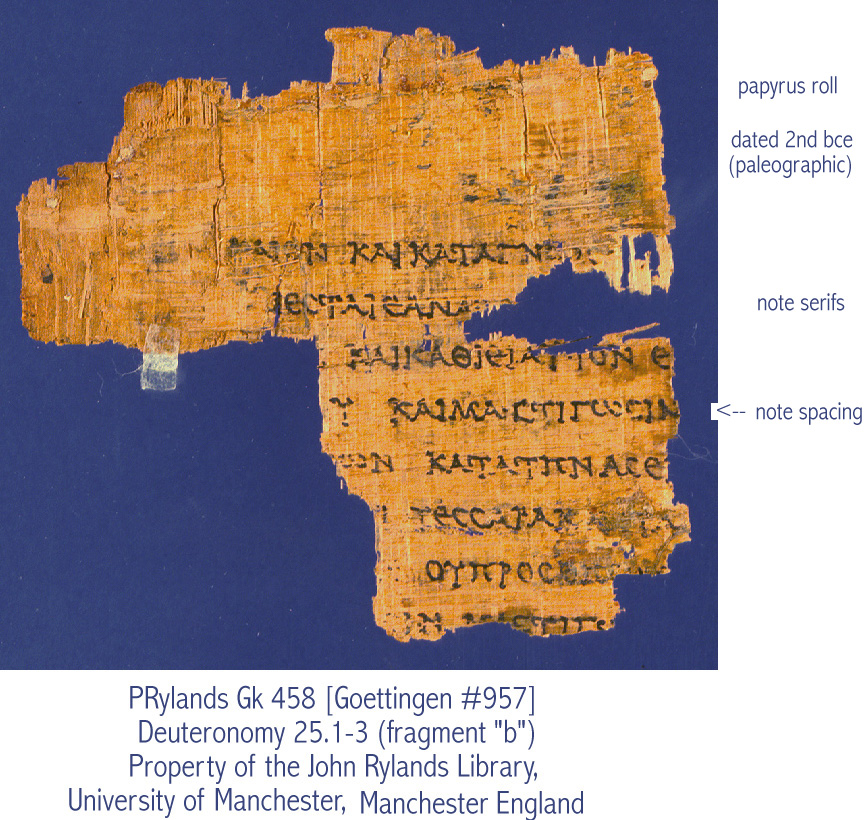
“In fact, the ONLY Greek manuscript of the Old Testament from before the time of Christ in existence today is Ryland's Papyrus #458, which contains only 6 chapters of Deuteronomy. That's it.” (italics original)


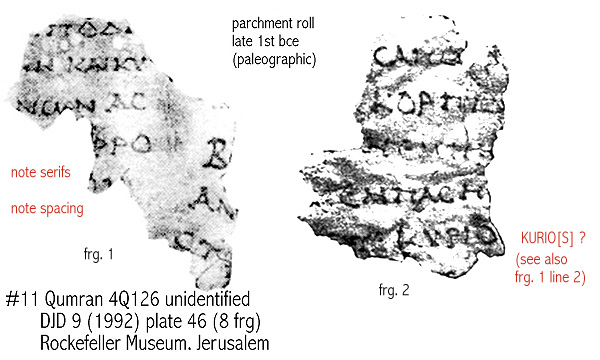
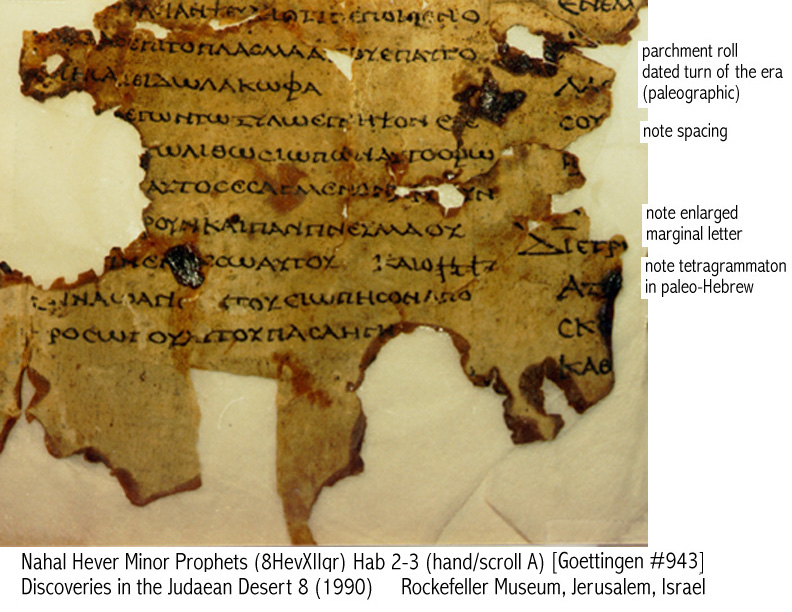
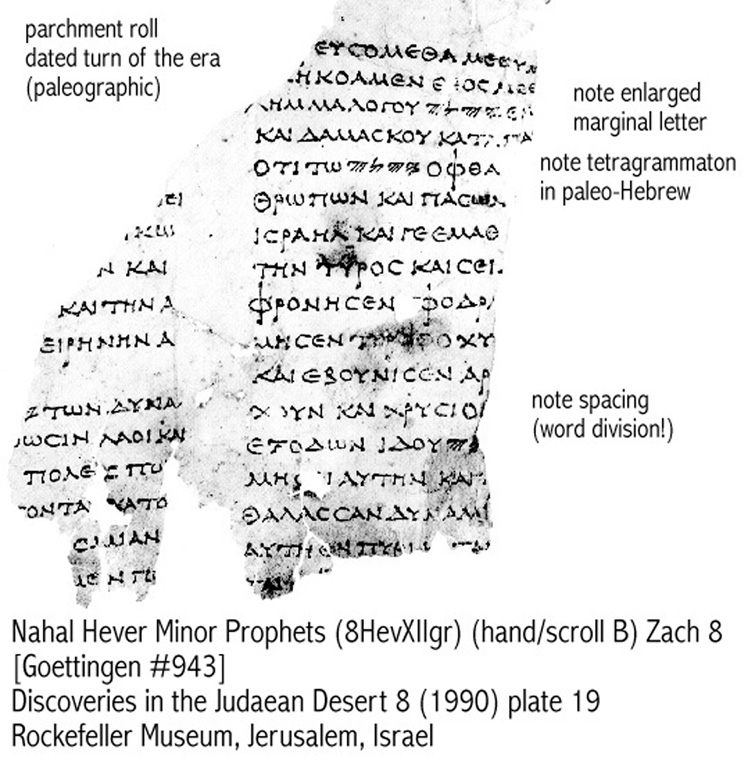
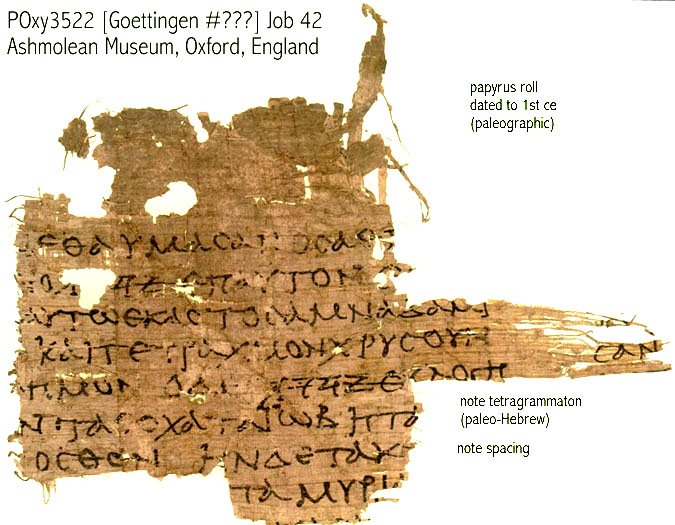
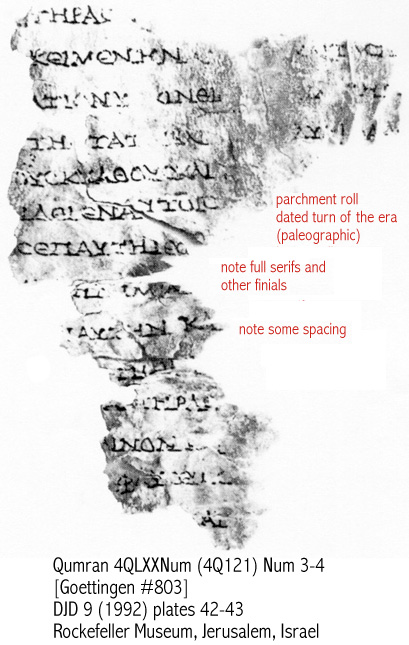
Without seeking to be to brusque, this statement is simply false.  Here is a list of papyri fragments prior to the time of Christ and their contents supporting the LXX:


2nd BC 
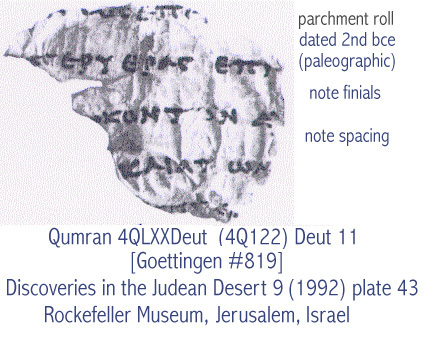
Dt 11.44QLXXDeut = 4Q122 ("leather" roll) [E. Ulrich, Studies J.W. Wevers (1984), p.71-82 = Disc. Jud. Desert 09 122]2bce[#819] LDAB 3458 [K. Treu, Archiv 31 (1985), p.59 no.55b]
Dt 23-28PRyl 458 (roll)(sp, high dot) [C.H.Roberts, Bull. J.Rylands Library 20 (1936), pp.219-245]2bce[#957] vh057 t039 LDAB 3459
2nd/1st BC   
Ex 287QLXXEx (roll) [check dating; LDAB 000 (confused?)]2/1bce[#805] vh038 LDAB 3456 AlandAT18
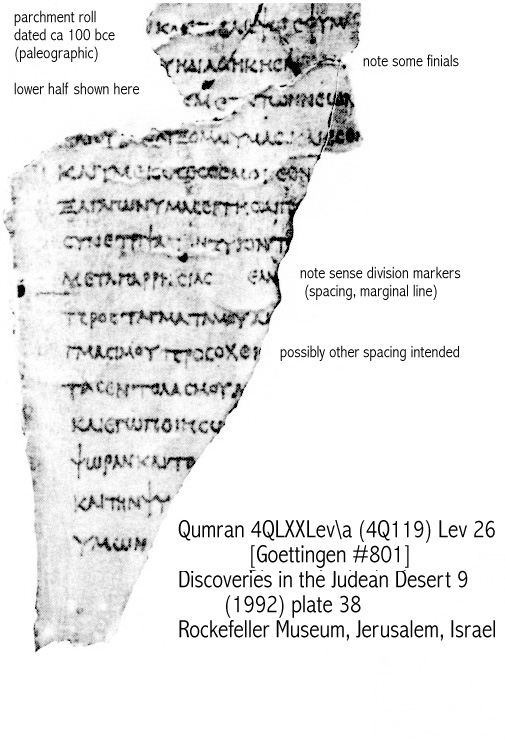
Lev 264QLXXLev\a ("leather" roll)(blanks) [check dating; LDAB 000]2/1bce[#801] vh049 LDAB 3454
EpJer/Bar67QLXX EpJer (roll)2/1bce[#804] vh312 LDAB 3460 AlandAT144
1st BC   
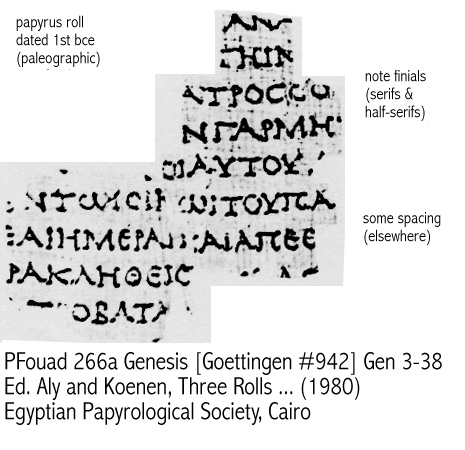
Gen 3-38PFouad 266a (roll)(sp, blanks) [Zaki Aly - L. Koenen, Three rolls of the Early Septuagint, 1980]1bce[#942] vh056a LDAB 3450 AlandAT3 [K. Treu, Archiv 28 (1982), p.91 no.5a]
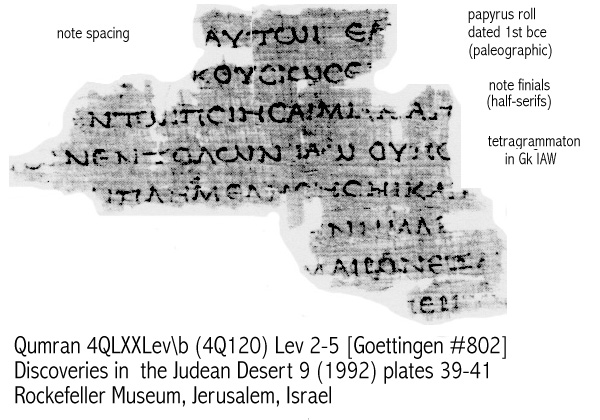
Lev 2-54QLXXLev\b Jerusalem, Rockefeller Museum (roll)(sp, blanks, paragr, IAW)1bce[#802] vh046 LDAB 3452 AlandAT22
Dt 17-33PFouad 266b (roll)(sp, blanks, paragr, Heb tetragr, stichometric in 32) [Zaki Aly - L. Koenen, Three rolls of the Early Septuagint, 1980]1bce[#848] vh056b t037A LDAB 3451 Aland01 = AT27 [K. Treu, Archiv 28 (1982), p.91]
late 1st BC   
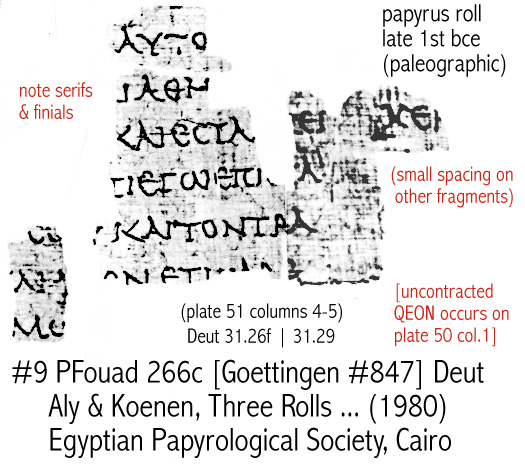
Dt 10-33PFouad 266c (roll)(sp) [Zaki Aly - L. Koenen, Three rolls of the Early Septuagint, 1980]1+bce[#847] vh056c LDAB 3453 Aland01; [K. Treu, Archiv 28 (1982), p.91 no.55a]
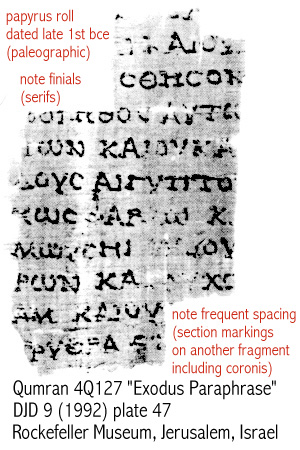
 4Q127 (Greek paraphrase of Exod?)1+bce 
 4Q126 (unidentified Greek, skins)1+bce 
turn of era   
Nm 3-44QLXXNu ("leather" roll)(sp)000[#803] vh051 t036A LDAB 3455
MPrs-ANahal Hever hand A ("leather" roll[s], two hands, A and B)(sp, blanks, paragr, ekthesis, paleo tetra) [D. Barthe/lemy. Les devanciers d'Aquila (1963); B. Lifshitz, Isr. Explor. Journ. 12 (1962), p.201-207; E.Tov, R.Kraft, P.Parsons, The Greek Minor Prophets Scroll from Nahal Hever, Disc. Jud. Desert 08] [Parsons 1+bce?]000[#943a] vh285 LDAB 3457
MPrs-BNahal Hever hand B ("leather" roll[s], two hands, A and B)(sp, blanks, paragr, ekthesis, paleo tetra) [see above]000[#943b] vh285 LDAB 3457
1st BC   
Job 42POxy 3522 (roll, paleo tetragr, sp)  

*MPrs means the Minor Prophets

It cannot be overstated that simply because these are the fragments and scrolls remaining, this does not mean that theses were the only books copied.  It is not uncommon for members of the IFB/NIFB to ignore historical evidence that can’t be manipulated in their favor.  This is another important trait to keep in mind when facing the claims made by the group.  The manuscript evidence alone is devastating to the NIFB position, that the LXX was created after the 2nd century AD.

Jesus and the Apostles


The final argument is that Jesus and the apostles never used the LXX.  Many of you reading this article have undoubtedly heard for a long time that many (if not most) of the OT citations in the NT are from the LXX.  From one NIFB website, the claim reads this way,


Many scholars claim that Christ and his apostles used the Septuagint, preferring it above the preserved Hebrew text found in the temple and synagogues. But if the Greek Septuagint was the Bible Jesus used, he would not have said,

‘For verily I say unto you, Till heaven and earth pass, one jot or one tittle shall in no wise pass from the law, till all be fulfilled.’ (Matthew 5:18)

Why would Jesus not have said this? Because the jot is a Hebrew letter, and the tittle is a small mark to distinguish between Hebrew letters. If Jesus used the Greek Septuagint, His scriptures would not have contained the jot and tittle. He obviously used the Hebrew scriptures!

In addition, Jesus only mentioned the scripture text in two ways, (1) ‘The Law and the Prophets’ and (2) ‘The Law of Moses, the Prophets and the Psalms’:

‘And he said unto them, These are the words which I spake unto you, while I was yet with you, that all things must be fulfilled, which were written in the law of Moses, and in the prophets, and in the psalms, concerning me.’ Luke 24:44

The Hebrews divide their Bible into three parts: the Law, the Prophets and the Writings. Jesus clearly referred to this. The Septuagint had no such division. In fact, it contains Apocryphal books interspersed throughout the Old Testament. The sequence is so hopelessly mixed up that Jesus could not possibly have been referring to it!”


You’ll notice right away that no attempt is made to actually address the use of the OT by Jesus or the apostles, merely an attempt to avoid the issue by suggesting that when Jesus spoke about the OT, he used Hebrew terminology.  Of course, Jesus used Hebrew terminology! He was a Hebrew! He was speaking to Hebrews!  Most likely in Hebrew (or Aramaic)!  The existence of a Greek OT does not preclude the use of the Hebrew nor does it mean that all references to the Hebrew Bible would cease.  Arguments like the one made above do not address the issue, they merely avoid it.

There are numerous places where the NT citation of the OT do not match the Hebrew, I will only list four for the sake of brevity:


1.  Ps. 40:6: “Sacrifice and offering you did not desire, but my ears you have pierced.” (Hebrew)
Ps. 40:6: “Sacrifice and offering you did not desire, but a body you have prepared for me.” (LXX)
The LXX translation is considerably different than the Hebrew, and it is the LXX that is quoted in Hebrews 10:5

2.  Is. 29:13: "Wherefore the Lord said, Forasmuch as this people draw near me with their mouth, and with their lips do honour me, but have removed their heart far from me, and their fear toward me is taught by the precept of men: (Hebrew)

Is. 29:13: "And the Lord has said, This people draw nigh to me with their mouth, and they honour me with their lips, but their heart is far from me, but in vain do they worship me, teaching the commandments and doctrines of men." (LXX)

In Mark 7:6-7 Jesus states that he is quoting the prophet Isaiah and reads the above verse from the LXX.

3.  Is. 28:13: "Therefore thus saith the Lord GOD, Behold, I lay in Zion for a foundation a stone, a tried stone, a precious corner stone, a sure foundation: he that believeth shall not make haste." (Hebrew)

Is. 28:13: "Therefore thus saith the Lord, [even] the Lord, Behold, I lay for the foundations of Sion a costly stone, a choice, a corner-stone, a precious [stone], for its foundations; and he that believes [on him] shall by no means be ashamed." (LXX)

Both the apostle Paul in Rom.9:33 and 10:11, and the apostle Peter in 1 Pet.2:6 quote teh LXX version of this passage.

4.  Gen. 47:31: “Israel worshipped as he leaned on top of his bed.” (Hebrew)
Gen. 47:31: “Israel worshipped as he leaned on top of his staff.” (LXX)
This is the text quoted in Hebrews 11:21.


The simple fact is that the overwhelming evidence from the words of Jesus and the apostles is that the LXX existed and was used in the 1st century AD.  The only way around this issue is to suggest that the OT citations were somehow changed before the oldest manuscript copies that we currently possess were made.  However, the only way to make this claim is to call into question the entire reliability of the Bible, something NIFB proponents will not do.

Conclusion


The evidence in support of the existence of the LXX is far greater than the NIFB would like to suggest.  They gather support among their followers by selectively picking which data they will use and attacking any other evidence as being heretical, without actually engaging with it.  This is the standard practice for most beliefs in the NIFB and they must be avoided.  Behind this challenge to the LXX is the actual reason, the earliest full Greek OT copies come from Codex Sinaiticus and Vaticanus.  These two Greek Bibles are rejected by the NIFB as a forgery (Sinaiticus) and Roman Catholic corruption (Vaticanus).  Why?  Because they contain the apocrypha, or books believed by many in the Protestant church to be non-canonical.  For the NIFB it’s an all-or-nothing situation.  There can be no room made for the possibility that apocryphal books were included for any reason other than canonical purposes or even that the church being entirely Greek/Latin speakers with no knowledge of Hebrew had no idea that these books were not received in the Hebrew tradition.  This approach demands that they create conspiracies to explain the historical data that doesn’t conform to their position.

Certainly, the differences in translation between the Hebrew and the Greek OT bring up theological questions.  Some of which I have addressed here.  But the answer to these questions is not to develop an elaborate conspiratorial house of cards.  Such an approach only guarantees the damage of believer’s faith when they see the evidence for themselves.  In reality, the existence of the LXX is one of the most important literary finds in Christian and Jewish antiquity, as it opens our eyes to the world of Hellenistic Judaism and the early church.  It did exist, and it is not a threat